
ISOFIX vs Seat Belt — Is One Safer?
Ask most parents which is safer — ISOFIX or a seat-belt install — and the answer is instant: ISOFIX. It feels modern, “click and go,” and less prone to mistakes.
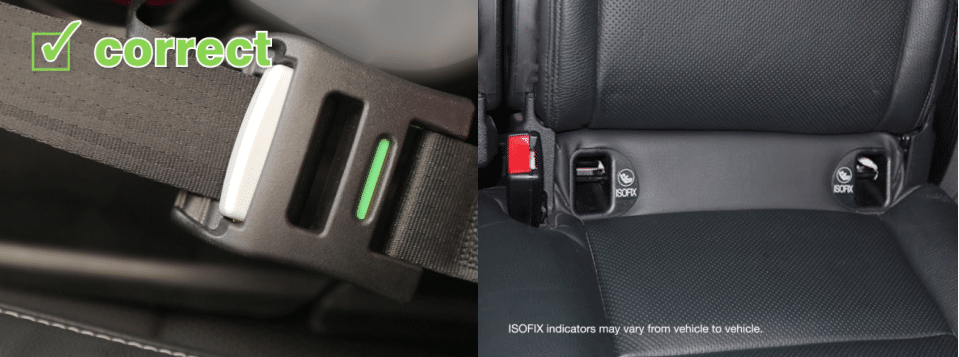
That confidence doesn’t always match what we see in real cars. Neither method is automatically safer. Both fail when tension, connectors or the extra stabiliser are skipped. Related: common installation mistakes.
The real question in ISOFIX vs seat belt is not which badge is newer — it is whether that install is tight, complete and legal for your seat and car.
Where ISOFIX came from
ISOFIX was developed by Britax and Volkswagen in 1997 to cut the errors people made with a vehicle belt. The aim was a more standard, simpler connection — not a system that always beats a correct belt install.
That distinction explains a lot of what we see on fittings: ISOFIX can be excellent when the car and the checks line up. It can also look “clicked in” and still be loose.
ISOFIX isn’t automatically safer
How well it works depends on the car’s anchors and cushion — not just the seat.
Shallow anchors
If the ISOFIX point sits proud of the seat or isn’t recessed enough, it is hard to get real tension on the connectors. A click is not the same as a tight install.
Deep or soft cushions
A thick or squashy base can sit between the seat and the anchors and steal tension the same way.
A belt install has different weak points
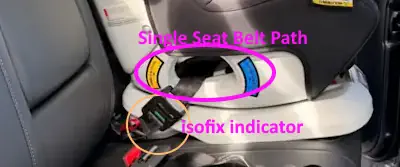
Belt installs are often harder to do well. They don’t fail for the same geometry reasons as a shallow ISOFIX pair. When the belt is locked and tight, the result can be as stable as a good ISOFIX fit.
Why “ISOFIX is safer” sticks
Part of the reason ISOFIX has such a strong reputation is that most people never look closely enough to notice when it’s gone wrong. A “clicked in” ISOFIX seat feels secure, so it’s assumed to be correctly installed. In reality, several checks are commonly skipped or misunderstood:
The result is a system that has a strong reputation for safety, propped up more by perceived ease-of-use than by consistent real-world execution.
Seat-belt installs have their own pitfalls
Clips exist because a belt path can look tight and still creep. Designs you’ll hear about include the standard locking clip, Safe-Grip, Exactus and Lockie — use only what your seat allows.
Stretchy or buried stalks
Hard to buckle and lock if the stalk is recessed or very elastic.
Clip upside down
A curved clip the wrong way holds nothing. Same false confidence as a loose ISOFIX click.
It takes effort
A proper belt install often needs more force than people expect — more than ISOFIX when ISOFIX is working.
ClickTight and SmartLock
Some newer seats lock the vehicle belt inside the restraint (Britax ClickTight, Maxi-Cosi SmartLock and similar). You still use the seat belt and a tensioning device to secure the car seat in without any additional locking clips, Exactus or Safe-Grip if the seat is designed that way.
That can be easier in a tight row (see three-across) and on cars with awkward ISOFIX. It is still a belt install. Tension and the tether or support leg still matter.
Capsules
Britax B-Pod Lite uses ClickTight — the vehicle belt locks in the seat, no extra clip. B-Pod hire
Convertibles / 360s
Examples include Maxi-Cosi Tuva, Pria, Raia 360; Britax B-First and B-Grow; Safe-n-Sound Polar 360; Joie i-Spin / Asset Spin 360; Nuna Rava / similar 360s — always confirm the lock type on the label and manual.
So which is safer?
Neither method wins on its own. ISOFIX’s advantage is consistency when the anchors, indicator, and leg or tether are all correct. A belt install can be just as secure; it usually needs more attention and a clip that actually locks.
Each exists because seatbelt installation, while capable of being very secure, has its own set of common failure points — and clip design has evolved specifically to address them. All of the above when used correctly result in a secure seatbelt installation and in many cases is easier than isofix. If you’re not sure, get it checked. See professional restraint fitting and fitting three-across (where the middle seat is almost always a seat-belt installation).
Isofix vs seat belt — FAQ
Is ISOFIX safer than a seat belt?+
Do I still need the top tether with ISOFIX?+
My car is older — can I add ISOFIX?+
Which should I use for three-across?+
Not sure the click is actually tight?
ACRI accredited mobile fitting across Bayside and the South East — ISOFIX or belt.
This post is general safety information only. Follow your seat manual and vehicle handbook. It is not a substitute for a certified child restraint fitting.