
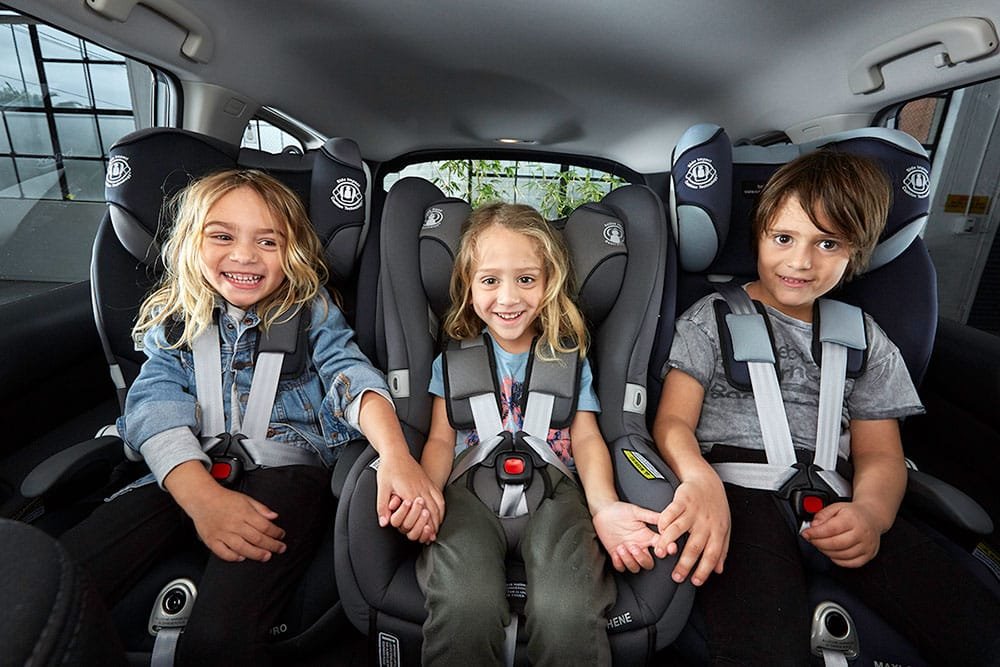
Fitting Three Across Car Seats in Melbourne
Fitting three child car seats across one row sounds simple — measure the row, measure the seats, done. In practice it is one of the trickiest jobs in child restraint fitting. A combination that looks installed can still fail a door, buckle or level check.
Here’s what usually gets in the way, how to test a combination, and when a car seat consultation saves buying the wrong three seats.
Why it’s harder than it looks
Isofix won’t do all three
Isofix locks a seat over its own anchor pair. That works for the two outboard positions in most cars. The middle place often has no Isofix, so the third seat is almost always a seat-belt install. You cannot “centre” three Isofix seats on two sets of anchors.
Bolsters eat width
Side wings and head-protecting bolsters are often wider than the base. Paper measurements can look fine and still fail at the top of the seat. Never crush EPS wings to make it “fit” — the seat must sit in its natural shape.
High-back boosters can be the weak link
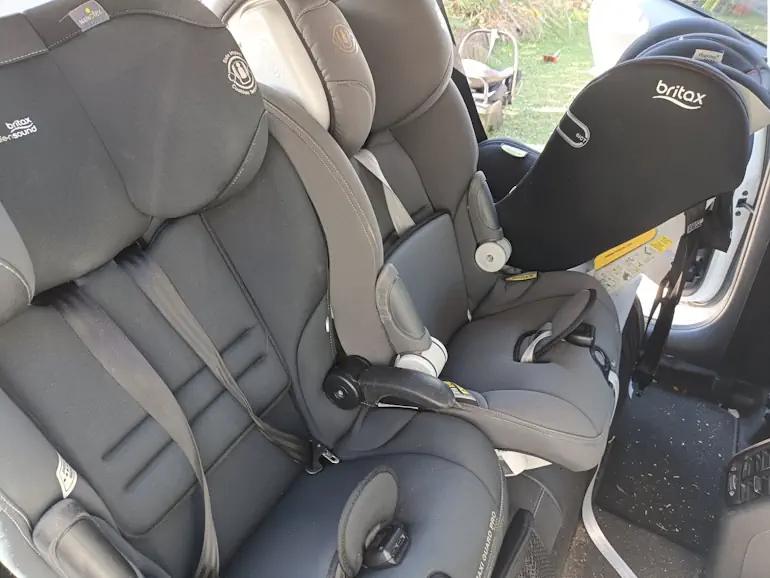
In a tight row there is often not enough room to route and buckle an adult belt around a booster. A fully harnessed Type G seat (for example a Britax Maxi Guard, where it suits the child) is often easier because the child buckles inside the harness.
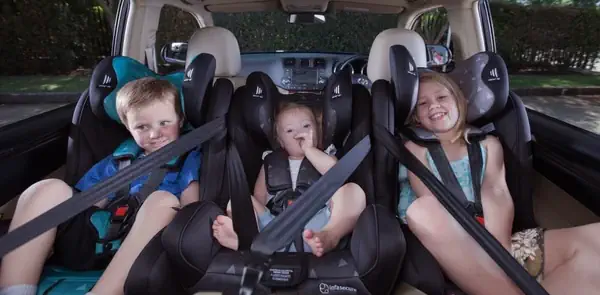
Seat selection matters more than the car brochure
If three-across is the goal, choose seats for width and install method — then test them together in your car.
Narrower options to try first
Britax Graphene, Maxi Guard (Pro and Basic) and Infa Secure Quattro are common starting points. None is guaranteed in every vehicle.
Measure the top, not just the base
Large side-impact wings can be wider at the top than the footprint. That’s often what blocks the third seat.
ClickTight / SmartLock help the last seat
Belt systems that lock in the seat can be easier in a tight row — they still have to fit width-wise. For a rear-facing infant in a three-across row, the Britax B-Pod Lite’s ClickTight is often the capsule that has a chance.
Never force the fit
If it only works by flexing wings or sitting a seat on a buckle stalk, that combination is out. Try another arrangement or a different model.
B-Pod Lite
Infant · ClickTight
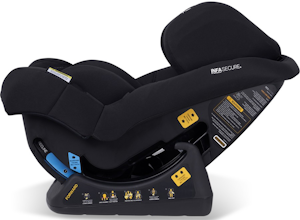
Eclipse
Low-profile rear-facing
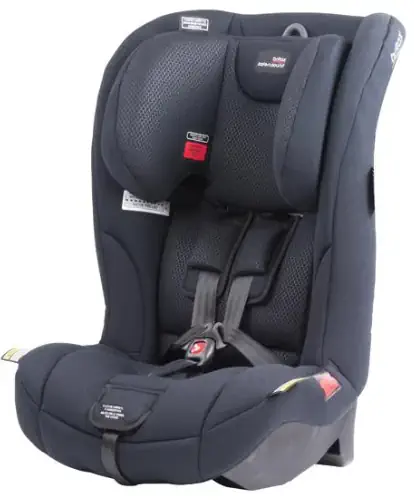
Maxi Rider
Convertible Booster seat
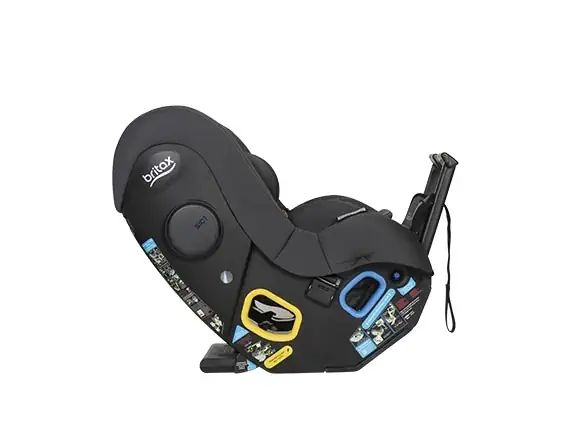
B-Compact Plus
Narrow convertible
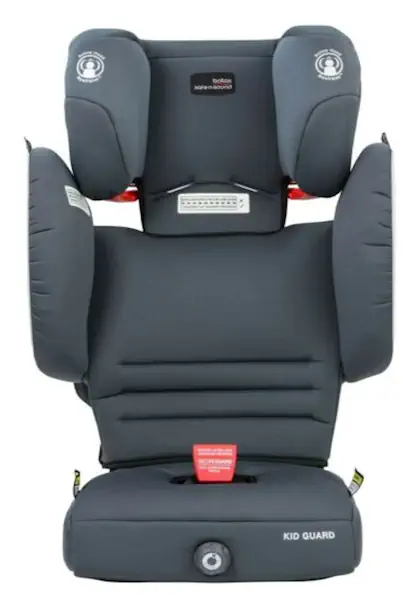
Kid Guard
Booster — often the tight one
Need a newborn in the mix? B-Pod hire · Extended rear-facing hire
How to test-fit
-
1
Start with the middle seat
If the middle restraint won’t sit level and clear of buckle stalks, that combination is unlikely to work. Rule it out before spending time on the outboard seats.
-
2
Add the two outer seats
A common trial is youngest toward the kerb side, then the remaining seat behind the driver — then swap if a door or tether fails.
-
3
Fail checks (any one is enough)
- Door will not close cleanly
- A seat sits on or compresses a buckle stalk
- A seat is perched on the vehicle bolster and not level
- Wings or shell are deformed to make space
If a check fails, change the seat or the order. Don’t persist with a bad fit.
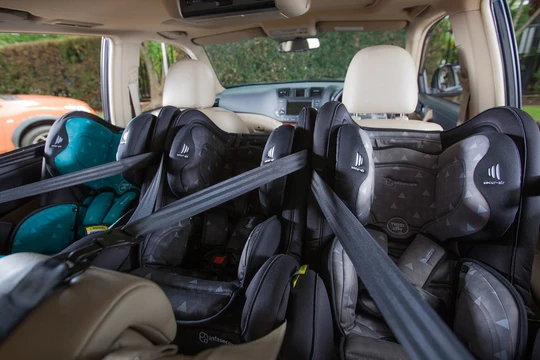
Installation order matters
Test-fit the middle first. When you install, don’t start there.
Usual order: start on the side with the easiest single buckle, work across, and leave the tightest position until last. ClickTight or similar locking systems are often easier as that last seat.
Exception: a rear-facing seat that must use the vehicle belt. Install that one first while you still have room to route the belt and any locking clip. If no outer position works, the middle may be the only remaining option — only if it still passes the checks above.
Exactus clip
Where the manufacturer allows it, an exactus clip that holds lap and sash together can make a rear-facing belt install more repeatable in a crowded row. Use only as the seat instructions permit.
B-Pod Lite in a 3-across row
When an infant capsule is one of the three, ClickTight on the B-Pod Lite avoids some of the belt-lock geometry that other capsules need. Still test width in the actual car.
Cars that often have a chance
Not every car will take three restraints in one row. Models we more often see work (with the right seats) include:
- Mazda CX-5, CX-7, CX-8 and CX-9
- Some wider older sedans — Toyota Camry, Holden Cruze / Astra in the right year
- Later Kia Sportage and Sorento
- Hyundai Palisade
If your car isn’t listed, three-across may still work — test rather than assume. Year, trim and even the presence of a centre armrest change the result.
In a nutshell
You can’t plan three-across from a spec sheet. It depends on the car, the three models, and the positions. Test combinations in person.
If you don’t want to buy three seats just to find out, hire and a consultation let you trial what actually fits — before number four means a bigger car.
Fitting three across Car Seats — FAQ
Is a slightly angled top tether OK?+
Can the seat touch the door?+
What about rear side-curtain airbags?+
Can I use Isofix for all three?+
Need three seats across?
Book a consultation or fitting. We’ll test combinations in your car across Bayside and the South East.
This post is general safety information only. It is not a substitute for your seat’s instruction manual, the vehicle handbook, current Australian Road Rules, or advice from a certified child restraint fitting technician for your children, seats and vehicle.