
Rear Facing vs Forward Facing: When Should You Switch?
Why longer rear-facing is safer — and when shoulder height markers matter more than age.
If you’ve stood in the car seat aisle looking at two similar seats — one rear-facing, one forward-facing — and wondered which your toddler actually needs, you’re not alone. It’s one of the most common questions parents ask. The honest answer: later than you might think.

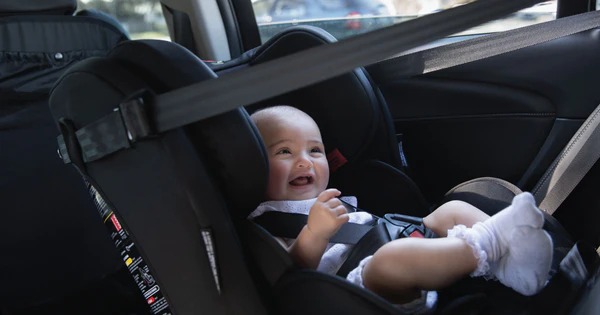
From birth, your baby should travel in a rearward-facing car seat or capsule. That position supports their head and neck and helps spread crash forces more evenly across the body. Options include infant capsules and combination seats that later convert to forward-facing.
Whatever seat you use, adjust and fasten the harness correctly on every trip.
The legal minimum vs best practice

In Australia, the law sets a minimum standard, not a “best time to switch.” Under the Australian Road Rules, children may legally move to a forward-facing seat from around 6 months of age in many situations — but “legal” and “safest” are not the same thing.
Kidsafe, state road authorities and child restraint specialists agree on a core point: the longer a child stays rear-facing (within the limits of their seat), the better protected they are. Rear-facing seats distribute crash forces across the back, shoulders and head more evenly than forward-facing seats — which matters for a young child’s developing neck and spine.
So while around 6 months can be the legal floor, it is nowhere near the practical ceiling.
The real marker: shoulder height, not age alone
The switch to forward-facing should not be driven only by a birthday. It should be driven by your child’s size relative to that specific seat.
Every rear-facing seat has shoulder height markers (sometimes more than one). Your child should stay rear-facing until they have outgrown the seat’s rear-facing limits — typically when their shoulders pass the relevant maximum rear-facing marker, as described in the manufacturer’s instructions.
As a practical guide, two things often need to line up before switching:
- Shoulders past the maximum rear-facing marker on that seat (check the manual).
- Stable, independent walking — a development sign many advisers use together with the seat markers, not instead of them.
If one applies but not the other, the safer default is usually to stay rear-facing until the seat’s limits say otherwise. Don’t switch early only because another child did at 12 months.
How height markers work

Don’t guess when to stay rear-facing — follow the shoulder height markers on the seat itself. They are the accurate way to know when a transition is allowed for that model.
Upper marker
Indicates the maximum shoulder height for that mode of the restraint. When your child’s shoulders reach the top marker for rear-facing, check the manual for the next step.
Lower marker
Often indicates a minimum shoulder height related to forward-facing. Below the relevant limit, your child should stay rear-facing. Always follow the labels on your seat.
Extended rear-facing

Extended rear-facing became more common in Australian seats after standards updates from 2014 onwards. Many AS/NZS 1754-certified seats allow rear-facing to around 30 months (about 2.5 years), depending on the model.
Under the updated AS/NZS 1754:2024 standard (phased in from late 2024), newer extended rear-facing seats can go further — some to around 36 months.
Always follow the labels and manual for your exact seat.
Extended rear-facing seats often have three shoulder height markers, with the highest acting as the exit or maximum marker for that mode.
If a seat only has two markers, it may not support extended rear-facing in the same way — turn the seat when the child passes the limit in the instructions. Models differ.
Standards and marker designs have shifted over time, so children may reach the forward-facing threshold later on newer seats than parents expect. Many infants will not outgrow rear-facing capacity at 6 months — and many can stay rear-facing well beyond the first birthday when the seat allows it.
Key takeaways
- • The ~6-month legal minimum is a floor, not a target.
- • Follow the shoulder height markers and manual for your seat — not the calendar alone.
- • Use stable walking as supporting context, not a reason to ignore the seat limits.
- • Newer seats (including those aligned with the 2024 standard) may allow rear-facing to about 30–36 months — so there is rarely a need to rush.

If your child has not yet reached the seat’s maximum rear-facing marker and is not walking confidently, there is usually no safety reason to switch early — and good reason to wait. When unsure, read the manual for your model or ask a certified child restraint fitter to check the seat in your car.
Keeping a child rear-facing as long as the seat allows is only one part of safer travel. Correct installation, harness use and the right seat for your vehicle matter just as much.
Need help choosing or checking a seat?
Book a consultation or mobile installation with an ACRI accredited fitter.
This post is general safety information only. It is not a substitute for your seat’s instruction manual, current Australian Road Rules in your state or territory, or advice from a certified child restraint fitting technician for your child, seat and vehicle.